The flight recorder for your AI work.
See what Claude Code, your agents and the apps you build with LLMs actually did: how long you waited, what it cost, and the one change worth making next. One binary on your machine. Your data never leaves it.
First open: right-click Aftertrace, choose Open, then Open again.
curl -fsSL https://rahulkraken.github.io/aftertrace/install.sh | sh

The questions it answers
Built for one person who builds a lot with AI, not for a platform team. No evals, no datasets, no dashboards to assemble.
Which session needs me right now?
Live lanes show every turn still running across your parallel sessions, what each is doing, and when one has gone quiet.
Where did my time go?
Wall clock split into model, tool runs, retries, hooks and the part that matters most: time waiting on you to approve something.
What did the agent actually do?
Each turn as a story: the steps in Claude's own words, every file it read or changed and every command it ran, and the moments it stopped to wait for you.
What one change saves the most?
Findings are SQL rules with an impact in seconds or dollars, the spans behind them, and a fix you can copy: an allow rule, a cheaper model, a cache.
What do my own apps cost?
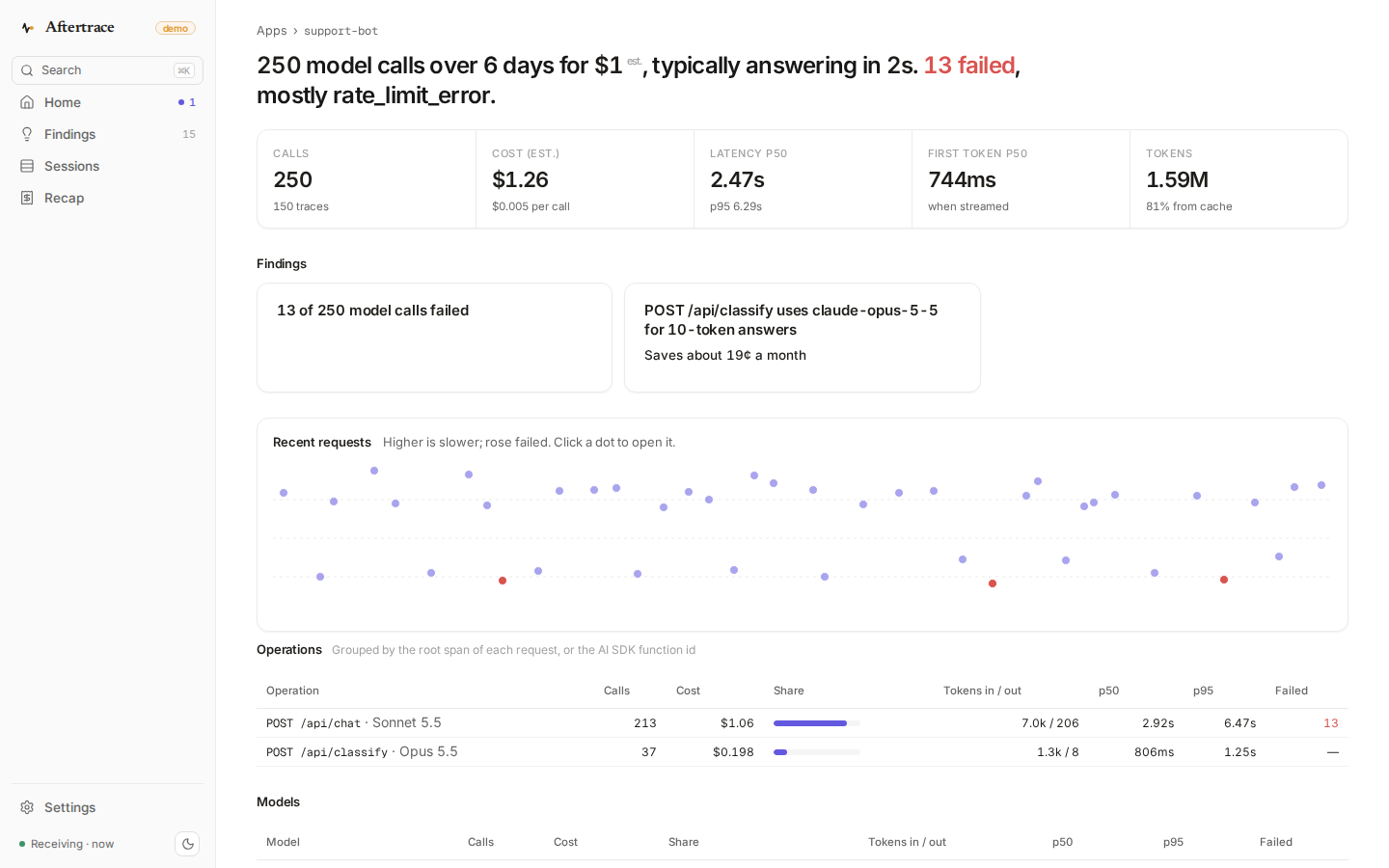
Point any app or agent that speaks OpenTelemetry at it. Calls, cost, latency and failures per app and per operation.
Did my plan pay for itself?
A weekly recap: hours of agent work, what shipped, API-equivalent value against your plan, as a receipt you can share.
Every turn, told as a story.
What you asked, where the time went in plain words, where it ended and which files changed. Then each step in Claude's own words, with its actions underneath: "Read orders.go", "Ran the orders tests". When Claude stopped to ask you something, that's a moment of its own, with the question and your answer.
- A Timeline view with the same steps on one axis, long waits folded
- Click any action for its input, output and cost
- Running turns appear while they run

One change at a time, ranked by what it costs you.
Fourteen rules ship today: permission prompts you always approve, retries, slow hooks, cache drops after compaction, skills that never activate, MCP tools that flood the context, and for your apps, models too big for the job, failing calls and prompts that are never cached. Each one is a SQL file you can read and change.
- Impact in seconds or dollars, never a score
- Evidence chips open the exact span
- A ledger of what fixes saved

Your Claude Code and your own apps, side by side.
Anything that sends OpenTelemetry GenAI spans shows up as an app: the Claude SDK, the Vercel AI SDK, Pydantic AI, OpenLLMetry, OpenInference. Model calls are recognised across conventions, agent spans are never double counted, and cost is estimated from tokens when an app does not report it.
- Per operation: calls, cost, p50 and p95, failures
- Traces in the same waterfall
- Rules written for apps
Your week, as a receipt.
Hours of agent work, lines shipped, minutes spent waiting, and what the week was worth at API prices against what your plan costs. Copy it as an image. Prompts stay hidden unless you turn them on.

How it works
One binary, three ports, one file. Point at a part to read it; click it to see that part up close.
Local-first, by construction.
Binds to 127.0.0.1
The receivers and the UI listen on your machine only. No account, no cloud, no telemetry, no update check.
Content is opt-in, twice
Prompts, responses and tool output are dropped at ingest unless Claude Code sends them and you run with --store-content.
Identity is always dropped
Email, account and org ids, and your OS user name never reach the store.
Ask is the only exit
Plain-English questions are off by default. Turned on, they send the schema and query rows to the Anthropic API, nothing else.
One DuckDB file you can open, copy or delete. What is stored, exactly.
Where it fits
| Aftertrace | Usage readers | Built-in usage view | Team LLM platforms | |
|---|---|---|---|---|
| Time, not just tokens | Waiting on you, tools, retries | No | Partly | Latency |
| Live view of running sessions | Yes | No | No | No |
| Coding agents and your apps together | Yes, over OTLP | Coding agents | One tool | Apps |
| History beyond 30 days, across machines | Yes | One machine | Short window | Yes, hosted |
| Setup | Download, or one line, then optional live export | One command | Built in | SDK and a service |
| Data leaves your machine | Never | No | No | Yes |
Start in a minute
Download
Download for Mac. Open the DMG, drag Aftertrace to Applications. First open: right-click Aftertrace, choose Open. The CLI:
curl -fsSL https://rahulkraken.github.io/aftertrace/install.sh | shConnect
Live export is optional. The Connect page gives you the settings block for Claude Code (or the snippet for your app) and turns green when the first span lands.